Free IPTV vs paid IPTV: what you actually get for your money
Free IPTV is not a scam and paid IPTV is not automatically better. They are two different products solving two different problems,…
Read the guideReddit is the first place most people look before paying for IPTV — and it is also where a good share of the “recommendations” are planted by sellers. Here is how to read those threads properly, what experienced users genuinely agree on, and how to test any provider yourself in about twenty minutes.
If you search “best IPTV Reddit” you are doing the sensible thing. Nobody wants to hand $50 to a website they found through an ad, and Reddit at least looks like real people talking. The problem is that IPTV is one of the most aggressively astroturfed topics on the platform. Providers know exactly what you are searching for, and they have been seeding those threads for years.
That does not make Reddit useless. It makes it a source you have to read with a filter. I have spent the last four years on the operations side of a streaming service — the person who gets the message at 2am when a sports feed drops — and the threads still tell me something useful. Just not the thing most people take from them.
Traditional review sites failed this category completely. Search “best IPTV 2026” and the first page is almost entirely affiliate content: the same eight providers, ranked by who paid the most, with screenshots that are three years old. Nobody testing those services actually installed them.
Reddit feels different because the incentive looks different. A comment from a user with a six-year account history and a post record full of woodworking and football banter reads as genuine. And often it is. The catch is that a convincing account is cheap. Aged accounts are bought and sold, and a seller only needs a handful of them to dominate a niche thread that gets forty comments a month.
So the value of Reddit is not the names people drop. It is the pattern of complaints. Complaints are much harder to fake at scale, because a provider seeding praise has no reason to write detailed negative posts about their competitors’ specific technical failures. When you read fifty threads and the same four problems come up over and over, that is real signal.
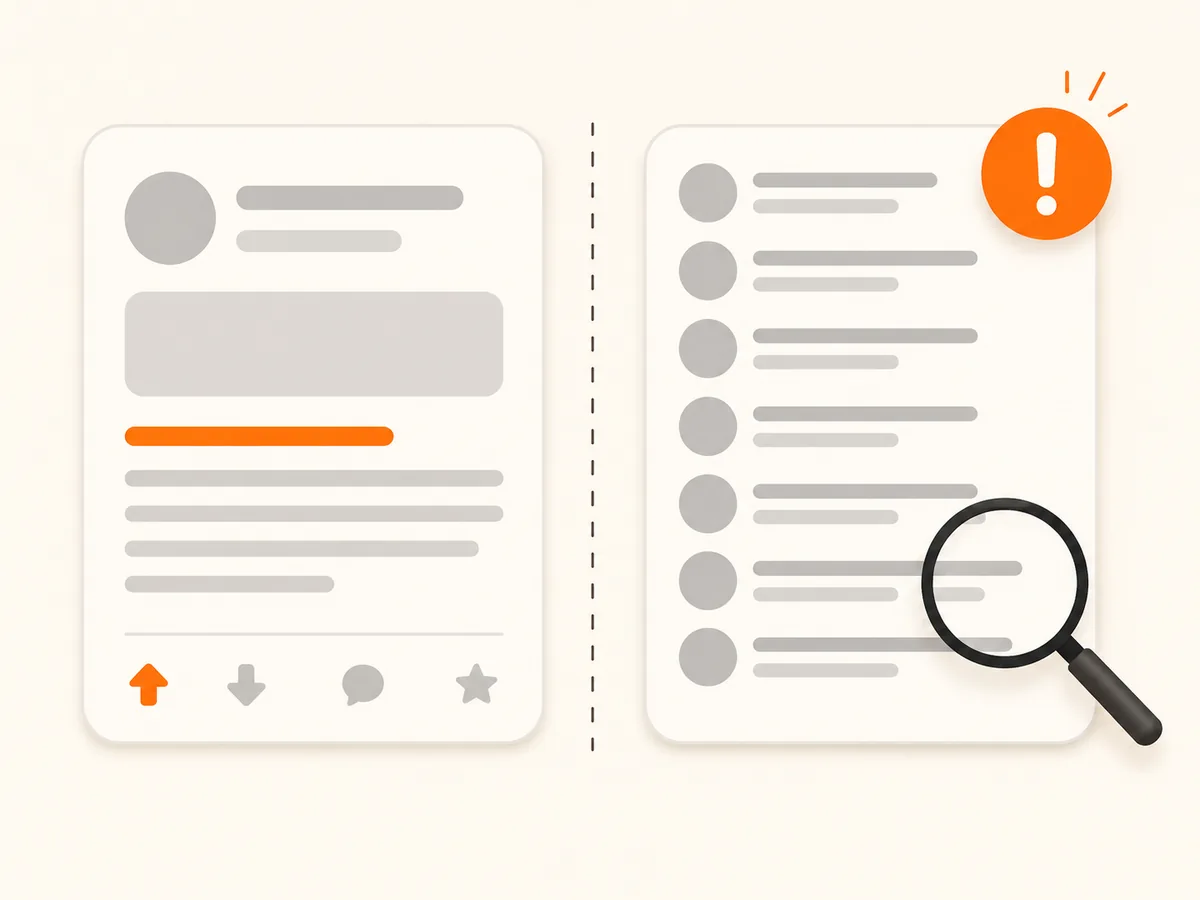
You do not need to be a forensic analyst. Four checks catch most of it:
Be equally sceptical of aggressive negativity. Competitors run smear comments too — vague accusations of “scam” with no order date, no plan name and no description of what actually failed. A genuine complaint almost always includes the boring details.
Strip away the brand names and the threads converge on a surprisingly consistent set of conclusions. This is the part worth writing down.
Nobody who has used IPTV for a year cares about the “20,000 channels” number in the ad. They care whether the eight channels they actually watch work on a Saturday afternoon. The single most repeated piece of advice on Reddit is some version of: check your channels at peak time, not at 11am on a Tuesday. Servers that look flawless midweek fall over when half of Europe tunes into the same match.
Multiple services often resell the same upstream feeds. That is why you will see one person swear a provider is perfect and another say it is unwatchable — they are in different countries, hitting different servers, pulling different sources for the same channel name. It also explains why “best IPTV” has no single answer: the right question is “best for my country, my channels, my hours”.
The most common regret post on Reddit is a two-year subscription bought from a provider that vanished in month four. The consensus advice is to start short, or at least start with a trial, and only commit to a long plan once you have watched through a full sports weekend without incident. Any seller who pressures you away from that is telling you something.
This one surprises people. Threads are full of comments saying the deciding factor was not picture quality but whether a human answered at 11pm on a Sunday. It makes sense: IPTV breaks occasionally no matter who you buy from. The difference between a good year and a bad one is whether someone fixes it in ten minutes or ignores you for three days.
A large share of “this service is terrible” posts get solved in the replies by someone pointing out that the poster is on 2.4 GHz Wi-Fi, or running a 4K stream through a five-year-old Android box with software decoding switched on. Before you blame a provider, it is worth eliminating your own hardware — and any provider worth paying will help you do that for free.
You will notice the same handful of brands surfacing across every thread. There are three reasons, and only one of them is quality.
The practical takeaway: treat a name you see repeatedly as a candidate, never as an answer. Then run the test below on it.
Since the whole point of this article is that you should compare rather than take one recommendation, here are three other providers that come up in the same threads. Open them, read their channel pages, ask each one about your specific channels, and take every trial you can get:
We are not going to pretend that pointing at competitors is selfless — we think we come out well when people actually test. But the alternative, telling you not to look, is exactly the behaviour this article warns about.

Every serious provider offers a trial line. Use it properly instead of clicking around at random. Here is the routine I would run on my own service, and on anybody else’s:
If a service passes all seven, buy the shortest plan. If it still holds up a month later, then extend. That sequence — trial, short plan, long plan — is the closest thing to consensus wisdom that Reddit has produced on this topic, and it is genuinely good advice regardless of who you buy from. If you are still weighing whether to pay at all, we set the two options side by side in free IPTV vs paid IPTV.
These come up in complaint threads with depressing regularity. Any one of them is enough reason to keep looking.

If the seller cannot tell you whether a specific channel is carried — and instead answers “we have everything” — they do not know their own catalogue. That is the single most reliable predictor of a bad year that I know of.
“Best IPTV” genuinely means different things in different places, and Reddit threads rarely separate this out. A few patterns that hold up:
Fair disclosure: this article is on the blog of an IPTV provider, and you should read the section below with exactly the scepticism this whole piece has been arguing for. So rather than tell you we are the best, here is how we do on the criteria above — including where we are ordinary.
| Reddit criterion | How Tivo 8K handles it |
|---|---|
| Trial before payment | Free 24-hour line, one per household, no card details |
| Start short, extend later | $12 one-month plan exists precisely for this |
| Human support at odd hours | WhatsApp, 24/7, average first reply about four minutes |
| Honest answers about the catalogue | Ask about a specific channel and you get yes or no, not “we have everything” |
| Peak-time stability | Load-balanced servers with automatic failover between sources |
| Written refund terms | Published in full, including what is not covered |
| “Everything in 4K” | No — and we say so. Major channels are 4K, many international ones are FHD, some regional feeds are SD at source |
If you want the honest version: the 55,000-channel figure counts quality variants, like every provider’s number does. What actually matters is whether we carry your twelve channels at a watchable bitrate on a Saturday. That is a question we can answer in one message, and the trial line lets you verify the answer without spending anything.
Ask for the free 24-hour line, bring your own list of channels, and test it at peak time on your own TV. If it does not hold up, you have lost nothing but twenty minutes.
Partly. Treat brand recommendations as unreliable and complaint patterns as reliable. The detailed, mixed, boring posts are usually genuine; the enthusiastic three-line endorsements usually are not.
The cord-cutting, streaming-hardware and device-specific communities give better technical advice than the IPTV ones, because they are less commercially targeted. You will learn more about fixing buffering there than about which brand to buy.
Because both sides are sometimes commercial, and because genuine experience really does differ by country and by server. Two honest users on different continents can have opposite experiences of the same provider.
Roughly $10–15 a month for a monthly plan, dropping to $3–5 a month equivalent on a yearly one. Far below that and something is being cut — usually server capacity, which you will discover at kick-off. Far above it and you are paying for marketing.
Yes, once the provider has proved itself over a month or two. Buying two years on day one is the mistake Reddit documents most often. Buying two years after a good season is just sensible economics.
The short version of everything above: use Reddit to learn what goes wrong, not to learn what to buy. Then take a trial, test your own channels at the worst possible hour, and let the service prove itself. Twenty minutes of first-hand evidence outranks any thread.

Free IPTV is not a scam and paid IPTV is not automatically better. They are two different products solving two different problems,…
Read the guide
The Firestick is the most common IPTV device in the world, and also the most commonly misconfigured one. This is the exact…
Read the guide
Both get you watching. Only one gives you categories, a working TV guide, and a browsable film library with posters. If nobody…
Read the guide